

The notice ran in the local paper in Oxford and on the radio: wanted, people over 70 who are worried about their memory. Hundreds answered. Two hundred and seventy-one of them entered a trial with a simple design and a high stake: one tablet a day for two years, a brain scan at the start and at the end. Half got vitamins, half placebo. Until the end nobody, the doctors included, knew who was taking what.
What was measured is raw and literal: how much the brain had shrunk.
The brain is measured in millimeters
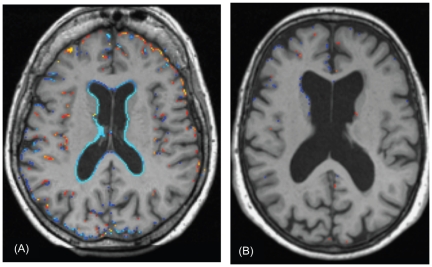
With age the brain slowly loses volume even in completely healthy people. In people with a mild weakening of memory the loss goes faster, and fastest of all in those who later develop Alzheimer's. That is why the rate of the shrinkage is not a curious detail but one of the hardest measurable signs of the direction a brain is going in.
The measurement is automated: software compares the two scan images, taken 24 months apart, and calculates the movement of the brain surface to an accuracy finer than the size of one voxel. The average brain in the trial is about 1,380 milliliters; the yearly loss is measured in fractions of a percent.
One tablet, three vitamins
The tablet contains 0.8 mg folic acid, 0.5 mg vitamin B12 and 20 mg vitamin B6. The three were chosen for one shared job: they run the processing of homocysteine, the amino acid whose higher levels in the blood are linked in a series of studies to faster brain atrophy and a higher risk of dementia. At these doses the vitamins bring homocysteine down by about 30%.
The logic of the trial is direct: if homocysteine is part of the mechanism, bringing it down should show up on the scan.
The result: a third slower
One hundred and sixty-eight people completed both scans. In the placebo group the brain shrank by an average of 1.08% a year. In the vitamin group: by 0.76% a year. The difference has high statistical confidence and amounts to about a third slower loss of brain volume. Serious adverse events were the same in both groups.
Strongest where homocysteine is high
The average figure hides the more interesting picture. In the participants with homocysteine above 13 micromoles per liter at the start, the vitamins slowed the shrinkage by 53%: by half. And in the placebo group the starting homocysteine flatly predicts how fast the brain will shrink over the next two years. In the vitamin group that link disappears almost completely: the line that climbs steeply on placebo is flat in the treated.
In other words, the vitamins do not just slow the average atrophy. They erase homocysteine's grip on it.
What follows from this
In the same trial faster shrinkage goes with a lower score on the cognitive tests at the end. The authors set out the arithmetic openly: about 16% of people over 70 have mild cognitive impairment, and half of them develop Alzheimer's; the accelerated atrophy is a mark of exactly those who get worse. Whether the same treatment can delay the disease itself, they write, further trials will have to show.
Until then what stands is what was measured: two years, one tablet a day, three B vitamins, and a brain losing itself a third slower. For people with high homocysteine: by half.
Sources
- A. David Smith et al., Homocysteine-Lowering by B Vitamins Slows the Rate of Accelerated Brain Atrophy in Mild Cognitive Impairment: A Randomized Controlled Trial, PLoS ONE 5(9), 2010: e12244.
- The full protocol of the VITACOG trial: ISRCTN 94410159.
- Kilmer S. McCully, Homocysteine, Vitamins, and Vascular Disease Prevention, The American Journal of Clinical Nutrition 86(5), 2007: 1563S–1568S.


