

The proof is caught in a place where blood is almost never taken: the vein between the gut and the liver. The blood there carries every just-absorbed substance in its original form, before the liver has touched it.
Fifteen minutes after a swallow of labeled folic acid, 80% of the folate found is still unchanged folic acid. With the other form tested the ratio is reversed: 96% is already 5-MTHF, the active form that normally dominates in the blood. The dose is the same. The route is not.
How is such an early moment in a vitamin's path seen at all?
Blood from a place where blood is not taken
The veins from the gut do not flow straight into the general circulation. They first gather into one large vessel that carries them to the liver: the portal vein.
An ordinary venous sample is taken from the arm, after that blood has already passed through the liver, the heart and the lungs and has mixed with the rest of the volume. The starting route has become part of a shorter combined result.
The six participants in the 2014 study already have a transjugular intrahepatic portosystemic shunt placed for medical reasons. The shunt creates a channel between the portal and the systemic venous circulation in the liver. Through it the researchers can pass a thin 65-centimeter catheter back to the portal vein. Its position is confirmed with real-time X-ray imaging.
That makes the unusual sample possible: blood after the gut and before the first pass through the liver. A second cannula in an arm vein allows systemic samples to be taken in parallel.
The heavier carbon marks the new dose
Folate already circulates in the body and is present in the food of the previous days. If a participant takes more of it, an ordinary measurement will struggle to tell the new dose from the existing background. So five carbon atoms in the test molecule are replaced with carbon-13.
Carbon-13 is a stable isotope. It takes part in the same chemistry as the more common carbon-12, but has one neutron more. The mass spectrometer separates molecules by their mass and their electric charge. When the labeled starting form is converted, the resulting molecule keeps the heavier carbons and stays distinguishable from the folate that was already in the body.
After a night without food the participants drink 30 milliliters of water with 500 nanomoles of the labeled folate form, as much as 220 micrograms of folic acid. The portal samples start at minute 15 and follow every ten up to minute 85. The systemic ones continue to the fourth hour.
All six complete the first part with labeled folic acid. Four come back for a second visit and repeat the procedure with labeled 5-formyltetrahydrofolate, also known as folinate. In them one and the same procedure puts the two routes side by side.
Folic acid arrives unprocessed
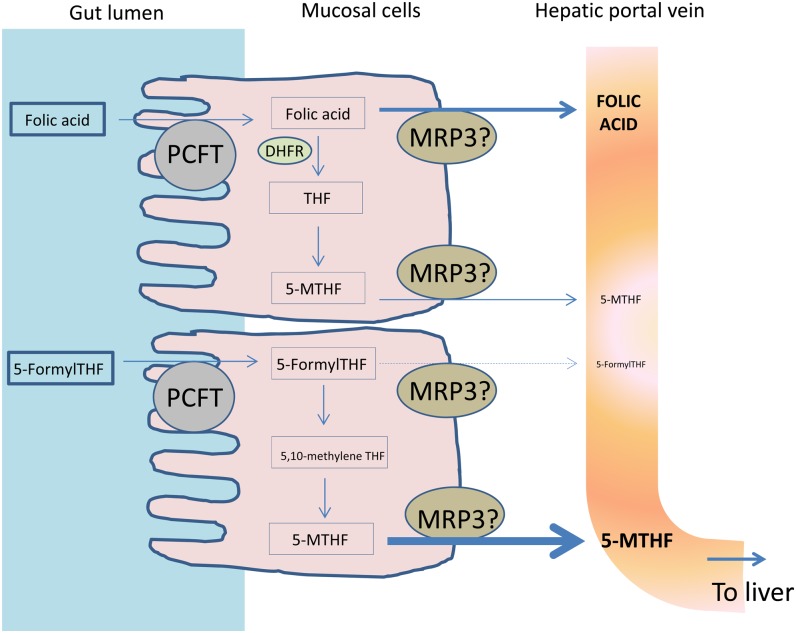
With folic acid, two labeled forms appear in the portal blood at minute 15. Among the participants with a detectable signal, 80 ± 12% of the labeled folate stays unchanged folic acid. The remaining 20 ± 12% is already 5-MTHF. In one of the six there is no detectable labeled folate in the first sample, so the ratio comes from the other five.
Folic acid is an oxidized molecule. To enter the cellular network of reduced folates it goes through two consecutive reactions. The enzyme dihydrofolate reductase first turns it into dihydrofolate, then into tetrahydrofolate. Only from there can the molecule be rearranged into the different carriers of one-carbon groups, including toward 5-MTHF.
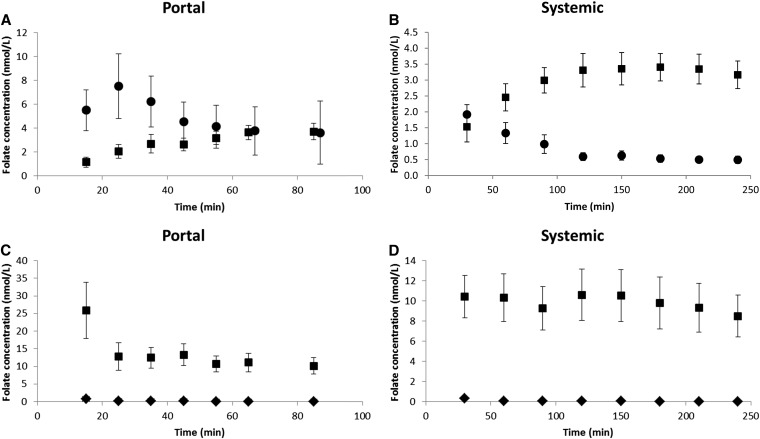
The first sample shows that part of the folic acid taken had left the gut wall before that sequence was finished. It reaches the portal vein in the same form in which it was drunk.
The concentration of the unchanged labeled folic acid peaks around minute 25, then falls. By minute 85 it is roughly equal to the concentration of the labeled 5-MTHF.
Folinate arrives ready
5-formyltetrahydrofolate starts from a different place in the same chemical network. It is already a reduced folate and does not go through the two opening reactions of dihydrofolate reductase. Cellular enzymes can convert it through other folate forms and reach 5-MTHF.
At minute 15 the ratio is almost the reverse of the one after folic acid. Among the four participants, 4 ± 18% of the labeled molecule stays as 5-formyltetrahydrofolate, and 96 ± 18% is already found as 5-MTHF.
The concentration of the labeled 5-MTHF is at its highest in the very first sample, at minute 15. After that its curve comes down to minute 85.
Here the gut wall is seen as metabolic tissue. Folate molecules pass through its cells toward the blood, and the enzymes in those same cells can change their form on the way. The identical sampling site makes it possible to see how different the chemical work done in the first 15 minutes is.
The bottleneck is in the human liver
After the portal vein the normal path of the blood goes through the liver. There the folate forms can be taken up, converted, held back or returned to the circulation. With this shunt part of the portal blood bypasses the liver, so the peripheral samples contain both blood that has passed through the liver and blood diverted through the channel. The first two routes are seen most cleanly in the portal samples.
When the unchanged folic acid enters the liver, the same two reductions still have to be carried out. The enzyme that has to process it works strikingly slowly in the human liver: in a separate laboratory experiment with samples from six human livers its average activity at physiological pH is under 2% of the rate measured in the rat. And it differs almost fivefold between individual people. The processing that is a quick step in the rat is a bottleneck in the human.
The catheter caught the difference before the first pass through the liver, while the clock in both cases still showed 15 minutes.
So the two words on the label do not say everything. The “folic acid” form waits in a queue in front of a slow enzyme. The ready form is 5-MTHF: the folate your blood carries around anyway.
Sources
- Ishrat M. Patanwala et al., Folic Acid Handling by the Human Gut: Implications for Food Fortification and Supplementation, The American Journal of Clinical Nutrition, 2014.
- H. Dencker et al., Portal and Peripheral Plasma Folates after Ingestion of Folic Acid, Acta Hepato-Gastroenterologica, 1976.
- Steven W. Bailey and June E. Ayling, The Extremely Slow and Variable Activity of Dihydrofolate Reductase in Human Liver and Its Implications for High Folic Acid Intake, Proceedings of the National Academy of Sciences, 2009.
- NIH Office of Dietary Supplements, Folate: Fact Sheet for Health Professionals.


