
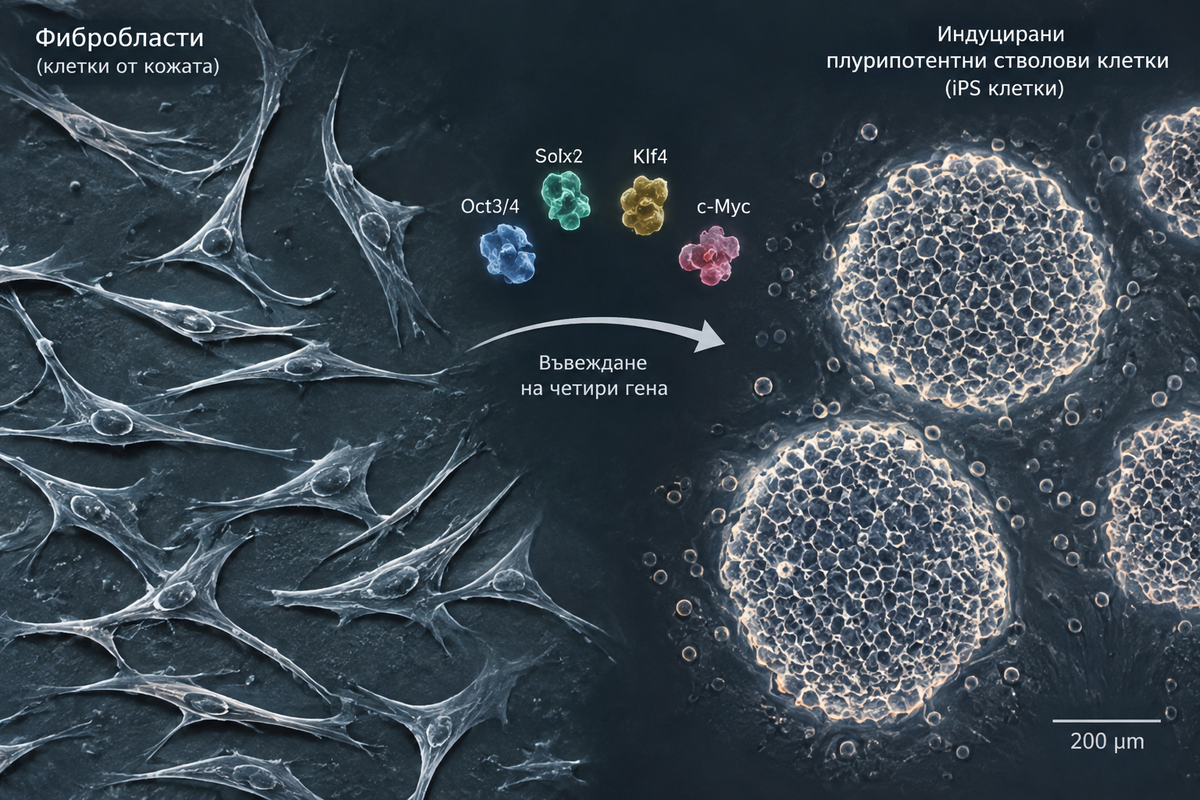
In the laboratory dish the flat cells are spread out in a thin layer. Then compact islands appear among them. The cells in the islands are small, packed tightly together and multiplying in a way that recalls colonies of embryonic stem cells.
Under the microscope the difference is visible at once. It appears after 24 candidate genes have been put into the cells.
Each of the 24 genes carries the instruction for a protein tied to the ability of stem cells to develop in different directions. The team of Kazutoshi Takahashi and Shinya Yamanaka did not yet know which ones were needed, so in 2006 they put all of them into mouse fibroblasts together, then tested mixes, each of them missing one candidate. The list melted away until four were left.
The experiment turned an old question into a task with 24 possible answers. Almost every cell in the human body keeps almost the same sequence of DNA. How is it then that some cells build skin, others carry electrical impulses, and others contract in the muscles?
The same library, different open pages
For a long time cell specialization looked like a one-way road. The early cell can give rise to many tissues. As development goes on, its options narrow: the nerve cell keeps one program, the muscle cell another, the connective tissue cell a third. The DNA stays almost the same, but different stretches of it are open and active.
The cell program is held in place at several levels. DNA is wound around proteins and gathered into a structure called chromatin. Some regions are open to be read, others are packed more tightly. Chemical marks on the DNA and on the proteins around it help keep that arrangement. Transcription factors recognize particular places on the DNA and direct the reading of whole groups of genes.
This network holds the cell identity. Open chromatin allows certain genes to be read, and the proteins and chemical marks carry the state through the next division.
Decades earlier, John Gurdon had already shown that the genome of a mature cell does not necessarily lose the information for a whole organism. When the nucleus of a specialized frog cell is put into an egg cell with no nucleus of its own, the surroundings of the egg can return that nucleus to development. Yamanaka set a narrower and bolder laboratory question: can a whole mature cell be taken back with a small, exactly defined set of factors, without an egg cell?
The list starts with 24 names
The team gathered 24 genes whose proteins are found in embryonic stem cells or take part in keeping their state. Each one is a reasonable candidate, but a reasonable candidate is not yet the cause. So all 24 went into mouse fibroblasts together: the flat connective tissue cells that can be seen in the first dish.
The genes were carried in by retroviral vectors. Once they are inside, the cells start to produce the corresponding proteins. If the combination manages to shake the fibroblast program and wake a program typical of a stem cell, the team needs a way to find the few changed cells among the thousands of unchanged ones.
That way is built into the mouse cells beforehand. In them Fbx15 is linked to a genetic marker that gives resistance to G418 when Fbx15 is switched on. The antibiotic removes the cells with no active marker; the resistant ones form the visible compact colonies.
All 24 candidates together give colonies. Now the team can start subtracting: one factor at a time, and then whole combinations.
The most important experiment is the subtraction
Takahashi began preparing mixes, each of them missing one candidate. If the number of colonies drops sharply without a given factor, that factor is probably part of the change. If removing it does not change the result, the factor can be dropped from the next round.
The first series singled out ten stronger candidates. Then the team repeated the logic on the shorter list and tested different combinations. At the end, Oct3/4, Sox2, Klf4 and c-Myc remained. When the four genes go into mouse fibroblasts together, resistant colonies appear again. When one of the key factors is missing, the change weakens or disappears.
The four genes code for transcription factors. Their proteins bind to regulatory stretches of DNA, change the activity of many other genes, and together set off the network of the pluripotent state.
The team called the cells they got induced pluripotent stem cells, or iPS cells. "Induced" means the state was brought about experimentally. "Pluripotent" means the cells can give rise to types from the three main germ layers, from which the tissues of the body develop.
A year later the flat cells are human
The first paper was about mouse embryonic and adult fibroblasts. In 2007 the team repeated the main intervention with fibroblasts from the skin of adult humans. Into them they put the same four genes. After a few weeks, dense colonies with clear borders appeared again among the flat human cells.
The look of them is the first clue. Now the colonies have to show what kind of cells they have become.
First the scientists looked for proteins on the cell surface that are typical of human embryonic stem cells. Then they compared the activity of thousands of genes. They checked whether key genes for the pluripotent state were active again and what the chemical marks around their regulatory regions looked like. They measured telomerase activity, one of the features of cells that can go on dividing for a long time.
Finally the scientists directed the cells toward derivatives of the three germ layers: ectoderm, mesoderm and endoderm. After injection into mice the cells formed teratomas with tissues from all three layers. One colony can now give cells with the marks of the lines that give rise to the nervous system and the skin; the muscles, the bones and the blood; the gut, the liver and other internal tissues.
What really went back
The sequence of the genome is not rewritten as a new text. What changes is the way the cell uses the text. The fibroblast program loses its ruling position; other regulatory regions open; networks switch on that can keep themselves going. During this transition, gene activity, access to the chromatin and epigenetic marks such as DNA methylation all change.
The epigenetic state is the stable way in which the cell arranges access to its almost unchanged DNA. In reprogramming, that arrangement passes through unstable intermediate states. A small part of the cells reach a colony in which the new program holds through the divisions that follow.
At the end of the experiment, four of the 24 names remain: Oct3/4, Sox2, Klf4 and c-Myc. Among the flat cells, compact colonies are visible. The DNA library is almost the same. What has changed is the program that chooses which pages stay open.
Sources
- Kazutoshi Takahashi and Shinya Yamanaka, Induction of Pluripotent Stem Cells from Mouse Embryonic and Adult Fibroblast Cultures by Defined Factors, Cell, 2006.
- Kazutoshi Takahashi et al., Induction of Pluripotent Stem Cells from Adult Human Fibroblasts by Defined Factors, Cell, 2007.
- Nobel Assembly at Karolinska Institutet, Mature cells can be reprogrammed to become pluripotent — Advanced Information, 2012.
- Shinya Yamanaka, The Winding Road to Pluripotency, Nobel Lecture, 2012.
- Matthias Stadtfeld and Konrad Hochedlinger, Induced Pluripotency: History, Mechanisms, and Applications, Genes & Development, 2010.


